

Hire AI engineers to work alongside your internal team.
Our engineers embed directly into your existing workflow, with access to your codebase, data infrastructure, and MLOps pipeline from day one.

Building LLM-powered features, automating workflows, scaling intelligent systems – none of them have room for on-the-job learning.
Get engineers who’ve already paid that tuition, production-hardened, technically deep, ready to contribute from day one.


Tap into AI software development services delivered by a seasoned team that owns every step.
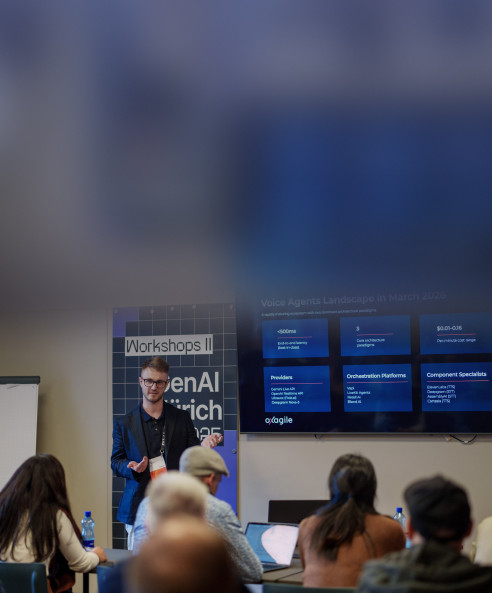
Nearly 80% of the team are senior-level engineers, averaging 10 years of hands-on engineering experience. They support complex architectures, performance-critical models, and stable pipelines without constant oversight or rework.
Published researchers on the team and engineers with academic lineage tracing back to Turing Award-winning labs. This isn’t experimental AI, they apply deep understanding of models and algorithms to real, production-grade work.
Our engineers build and scale products like Voiager from the ground up and bring that same ownership to client work. 350+ projects delivered, with full accountability across architecture, modeling, and iteration.






We’re building on top of LLMs but the system keeps breaking in unpredictable ways, like hallucinations, tool-calling failures, agents that loop or stall. We need engineers who understand how these systems actually fail, not just how to wire them together.

Without the right machine learning expertise, complex data is hard to turn into reliable, scalable systems. Algorithms often underperform, produce biased results, or fail under heavy load. And once integration breaks, progress stalls.

Like many organizations, we sit on massive amounts of data but struggle to extract value from it. Weak analysis drives bad decisions and inefficiencies, and inconsistent data pipelines cause delays, errors, and limited insight.

Raw visual data is everywhere, but making sense of it remains a struggle. Our projects face misdetections, slow analysis, and inconsistent results across devices, and our team wastes time on trial-and-error.

Human language is messy and nuanced, and systems often miss the context. Misunderstood queries, awkward or incorrect responses, unreliable translations, and frustrated users keep pulling our team into constant fixes.

Even with advanced AI, unclear priorities, misaligned goals, and inconsistent processes waste effort, miss deadlines, and produce features that don’t deliver. Coordination gaps and shifting requirements make it tough to turn AI into real outcomes.


Production deployments and agentic AI workshops, built and run by the same team. The shortest path to a working system is a conversation with someone already inside one.
 Augmentation
 Hire AI engineers to work alongside your internal team.
Our engineers embed directly into your existing workflow, with access to your codebase, data infrastructure, and MLOps pipeline from day one.
 Project-based
 We take a feature from spec to production: model training, integration, testing, and deployment.
Handoff includes documented architecture, reproducible training pipelines, and code your engineers can own without a knowledge transfer marathon.
 Dedicated team
 A persistent AI squad aligned to your product roadmap for the long haul.
They cover the full AI development lifecycle: experimentation, pipeline scaling, model governance, and iteration.

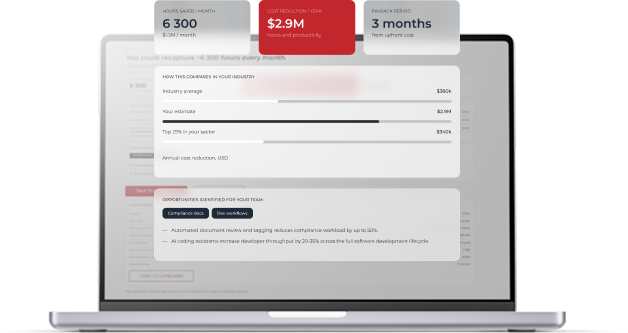
Put the specifics in, like scope, team size, use case, and get a grounded read on where the investment holds up and where it doesn’t.

With 20+ years in online video, our AI engineers build recommendation engines, adaptive pipelines, and moderation tools for millions of viewers.

Nearly 20 years in AdTech power optimization of DSPs, SSPs, and retail media platforms, turning fast-moving data into better targeting and campaign ROI.

Oxagile’s engineers develop personalized learning platforms and adaptive assessments, using AI, data-driven personalization, and scalable delivery.

Our experts design predictive routing, demand forecasting, and fleet optimization tools using real-time IoT and logistics data.

Specialists in fraud detection, risk scoring, and automated trading systems, providing real-time insights for high-volume, compliant financial operations.

We deliver telemedicine and patient monitoring platforms that convert real-time device and EHR data into secure, actionable insights.
OpenAI GPT, GPT-5 • Anthropic Claude family • Google Gemini family • AWS Titan models • IBM Granite models
Meta Llama 3.x family • Mistral and Mixtral series • Qwen family • DeepSeek V-series and R-series • Microsoft Phi-3 family • Stability AI series
Long-context transformers (xLAMs) • Multimodal LLMs • Code-optimized models (e.g., Code Llama, StarCoder 2)
PyTorch • Keras • scikit-learn • JAX • Hugging Face Transformers and Diffusers • PyTorch Lightning • JAX Flax • OpenAI and Anthropic toolchains • ONNX
LangChain • LlamaIndex • Nvidia NeMo • Vector Database • Sentence Transformers • Cohere Embed • Chunking, ranking, and hybrid search orchestration
Multi-agent orchestration • Tool-using and function-calling agents • Planning and reasoning support • Memory-augmented workflows
Supervised, unsupervised, self-supervised • Contrastive • Clustering and metric learning • RL/RLHF • Few and zero-shot tuning • RAG and tool use • Multimodal and cross-modal
The process usually starts with defining the problem you want to solve, such as building a model, integrating AI into an existing product, or taking a prototype into production. From there, we offer candidates with hands-on experience in relevant languages and ML frameworks, a track record of shipping production code, and familiarity with deployment and maintenance.
LLM systems, RAG pipelines, tool-calling, agentic orchestration, alongside computer vision, NLP, MLOps and ML infrastructure, and classical ML, also recommendation engines, anomaly detection, forecasting. If it runs in production, we’ve likely built something close to it.
Staff augmentation drops individual engineers into your existing structure, they work inside your team, under your processes. A dedicated team is a self-contained squad of 3–7 people with its own technical lead, reporting cadence, and full accountability for delivery. The first extends your capacity. The second replaces the need to build that capacity yourself.
Those planning to hire AI teams or individual AI developers look for those who know Python, R, Java, or C++, and frameworks like PyTorch or scikit-learn. Experience working with data processing, feature engineering, model training, deployment, and MLOps principles matters too.
Dedicated AI engineers focus on implementing and deploying models in production, writing scalable code, and maintaining systems. Data scientists focus on analyzing data, exploring patterns, and creating experimental models.
AI engineers are in demand across industries like finance, healthcare, AdTech, video and streaming, transportation, and education, often working on predictive analytics, recommendation engines, automation, or intelligent agents.